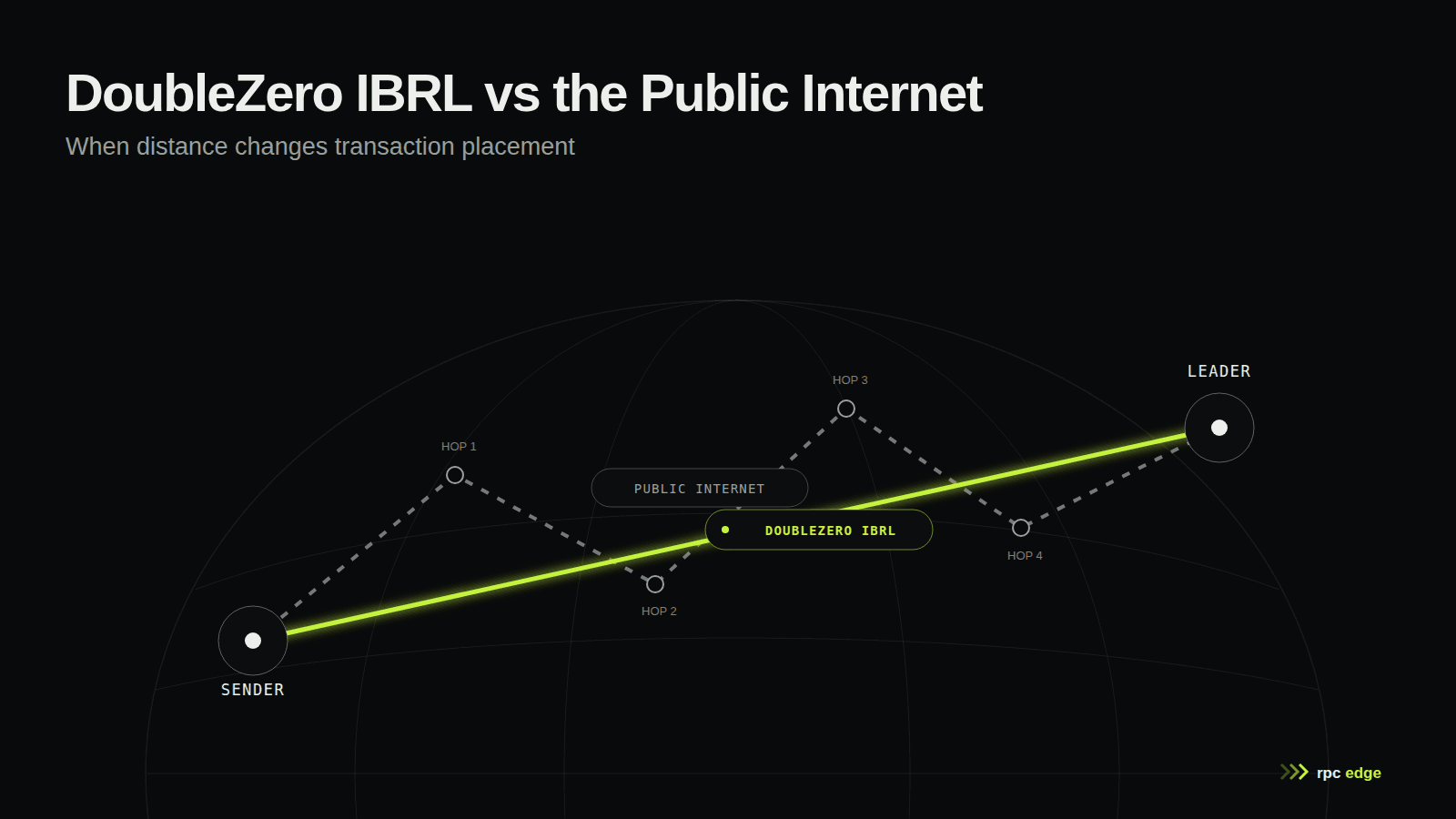
Most "latency benchmarks" are marketing screenshots. This one is a leader-paced paired A/B with published eligibility rules, same-slot tables, and an open harness.
If you route Solana transactions for a living, you care about produced-block order, not a vanity RTT tile.
The experiment in one screen
| Field | Value |
|---|---|
| Arms | DoubleZero vs Public Internet |
| Method | leader-paced paired A/B |
| Window | 1 hour |
| Captured | 2026-07-13 · 02:54 UTC |
| Route | DoubleZero IBRL vs public Internet · Frankfurt |
| Paired leader runs | 246 |
| Same-slot pairs | 201 |
| Leader identities | 29 |
| PoH candidate-or-tied | 98.0% |
Eligible windows only: the leader has DoubleZero TPU open. Both arms shared the Frankfurt host, relay binary, transaction shape, recent blockhash, slot trigger, and leader TPU endpoint.
Full tables: benchmark report.
Same-slot is the only fair table
A pair only enters the comparison when both arms land in the same produced slot. Different-slot and one-arm-only outcomes are coverage. They are not timing wins.
| Placement metric | DoubleZero earlier | Same | Public earlier |
|---|---|---|---|
| Preceding PoH ticks | 91 | 106 | 4 |
| Processed tx index | 115 | 0 | 86 |
| Entry index | 113 | 4 | 84 |
PoH ticks and processed transaction index describe block order. First-observed milliseconds include receiver and read-path noise. Treat placement as primary.
Distance is the real variable
Short-haul leaders and long-haul leaders are not the same race.
| Distance | Same-slot pairs | DoubleZero earlier | Tied | Public earlier |
|---|---|---|---|---|
| Under 1,000 km | 109 | 5 | 101 | 3 |
| 1,000-5,000 km | 1 | 0 | 1 | 0 |
| At least 5,000 km | 90 | 85 | 4 | 1 |
| Coordinate unavailable | 1 | 1 | 0 | 0 |
Under 1,000 km, most pairs landed in the same PoH interval. Beyond 5,000 km in this window, DoubleZero led on preceding PoH ticks in 85 of 90 same-slot pairs.
If your leaders sit next door, the public Internet path can look fine on PoH. If your leaders sit an ocean away, the route choice shows up in the same tables.
How to read without over-claiming
- Read eligibility first. Only windows that match the method count.
- Prefer placement metrics over observation time.
- Slice by distance before you generalize.
- One hour is evidence for that window, not a product promise.
- Open the harness if you disagree with the design.
Harness: solana-tx-bench.
Next
Open the full report, check the same-slot and distance tables, then run the harness on your own traffic shape if you need a second opinion.
All runs: /benchmarks.
If you want the same class of path control in production, get started or start self-serve on app..