New post when we ship something fast.
No noise. Just infra notes and shipping updates.
◢ Join TelegramRouting to the edge…
◆ THE RPC EDGE LOG
Deep dives on shreds, gRPC streaming, co-location, and the engineering behind landing transactions first. Written by the team running the nodes.
How Solana leaders turn blocks into shreds, fan them through a stake-weighted Turbine tree, recover packet loss, and expose first-seen data before confirmation.
Read the guideMORE POSTS
Copyable Yellowstone gRPC filters for Solana accounts, owners, memcmp data, transactions, slots, and account data slices, with the production rules that keep streams narrow and recoverable.
A field guide to estimating Yellowstone gRPC bandwidth from an exact filter, with conversion formulas and a measured RPCEdge Jupiter sample.
A practical telemetry model for measuring first-seen latency, decode and decision time, transaction landing, commitment, retries, and tail failures across a Solana trading pipeline.
A workload-first checklist for choosing JSON-RPC, WebSockets, Yellowstone gRPC, replay, and transaction sending without buying an HFT stack too early.
Move Solana reads, transaction delivery, and Yellowstone streams between providers with shadow traffic, acceptance gates, and a tested rollback path.
A practical guide to Solana priority fees: compute-unit limits, micro-lamport pricing, local fee markets, simulation, Jito tips, and adaptive fee policy.
How physical placement affects Solana read and send paths, what co-location means, and how to benchmark regions, routing, and tail latency without fooling yourself.
Decode Pump.fun v2 trades, quote mints, completed curves, and PumpSwap migrations from a replay-safe Yellowstone gRPC transaction stream.
A practical recovery contract for Yellowstone gRPC: slot checkpoints, replay overlap, deduplication, keepalives, gap alarms, and RPC reconciliation.
Build a replay-safe Solana wallet monitor with Yellowstone filter shards, complete account-key resolution, bounded queues, and reconciliation.
A practical TypeScript architecture for monitoring Meteora DLMM pools, maintaining local state, reconciling stream updates, and submitting bounded transactions on Solana.
A code-first TypeScript guide to watching a wallet with Yellowstone gRPC, decoding candidate swaps, controlling risk, and reconciling every action against Solana RPC.
Prepare Solana RPC, gRPC, and indexing systems for Alpenglow with a practical readiness worksheet.
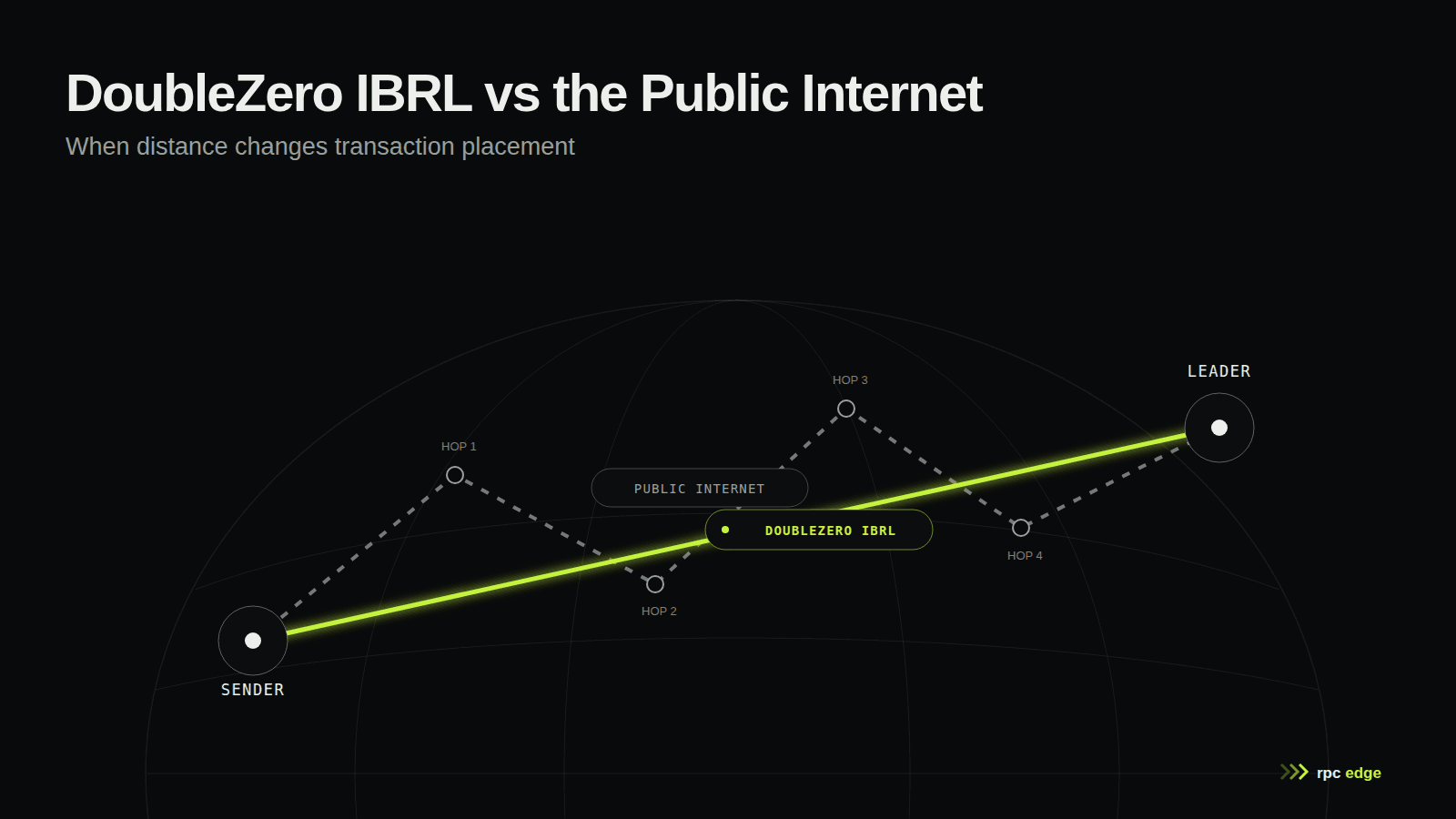
A paired Frankfurt benchmark compares DoubleZero IBRL with the public Internet and shows where network distance changed Solana transaction placement.
Poll, webhook, WSS, gRPC, or shred-class signal? A workload-first decision matrix so you stop buying the wrong firehose.
Leader-paced A/B from Frankfurt: for every eligible Solana leader with DoubleZero TPU open, one tx over IBRL and one over the public Internet. Same host, same relay, same slot trigger. Placement over vanity RTT.
55,424 matched Pump AMM signatures on mainnet from Frankfurt: pre-execution deshred vs processed Yellowstone gRPC. Same filter, same public TLS endpoint. First-seen is almost always deshred.
Jito ShredStream is free and everywhere, DoubleZero Edge is publishing 28ms-faster p95 numbers, and commercial feeds like Shreder sell decoded shreds by the month. An honest map of the options - and what it costs to run each one.
Syndica retired its RPC and ChainStream APIs on Feb 14, 2026 and told users to migrate to Yellowstone gRPC. What actually changes, how the subscriptions map, and how to land the migration on a co-located endpoint.
2,202 transactions through the co-located QUIC relay on Yellowstone TPU in Frankfurt. Observation rate 96.3%. Submit-to-deshred p50 104 ms. ACK is health, not landing.
What actually matters for HFT and trading bots: co-location with stake and Jito, first-seen shreds, single-tenant p99, and direct leader paths - not feature lists.
What Solana stake-weighted QoS changes, what trusted RPC-validator peering requires, and why better packet admission still cannot guarantee transaction landing.
The Solana JSON-RPC methods you'll actually use, what each one does, where they bite, and when to reach for gRPC or shreds instead.
Geyser is the plugin interface that lets account, transaction, and slot data flow out of a validator as it is processed. Here is how it works.
Copy-trading bots watch a target wallet and mirror its trades. The hard part isn't the logic, it's seeing the trade and landing yours before the edge is gone.
An arbitrage bot is mostly infrastructure, not strategy. Here's the ingest, decode, and execution stack a Solana arbitrage bot actually needs.
A current, source-linked comparison of RPCEdge, Helius, and Triton One for Solana RPC, Yellowstone gRPC, transaction sending, replay, and trading-bot workloads.
How Jito bundles, tips, and the Block Engine auction work on Solana - and when direct TPU delivery beats a tip for landing a single tx.
Compare Solana RPC providers for bots and apps: latency, Yellowstone gRPC, transaction landing, pricing units, and when dedicated nodes beat shared. 2026 buyer checklist.
Most Solana transactions don't fail on-chain - they never land. Fix expired blockhash, priority fees, leader delivery, and SWQoS under congestion.
A plain reference to Solana's commitment levels, what each one guarantees, and which to pick for reads, writes, settlement, and HFT signal.
A buyer's guide for HFT desks, funds, and serious bot builders. The criteria that decide your edge, the red flags that drain your budget.
From shred ingestion to landed transaction - a reference architecture for low-latency Solana trading, and where the milliseconds actually hide.
Sending a Solana transaction is easy; landing it fast, in the slot you wanted, is the hard part. How the leader schedule, the TPU, and Jito fit together.
"First-seen" means acting on a transaction while it's still propagating - before any node calls it confirmed. What that state is, and how to use it safely.
Polling RPC asks the node "anything new?" on a loop. Geyser-based gRPC pushes updates the instant they happen. How the two models differ - and when to use each.
Standard RPC shows you transactions after a block is confirmed. Shreds show them while it's still propagating - the foundation of low-latency Solana trading.
Polling a Solana RPC node asks the same question on a loop and pays in latency. Where the milliseconds go - and the architecture that removes them.
No noise. Just infra notes and shipping updates.
◢ Join TelegramSelf-serve plans start in minutes - and right now it's 50% off your first month.